
Human-in-the-loop content governance
Human approval should be a system control, not a hopeful instruction in a prompt.
Telling an AI system to be careful does not establish accountability. A dependable content workflow defines who reviews, what they can see, which version they approve and what technical event is allowed to publish.
Overview
The approval gate belongs between generation and external action
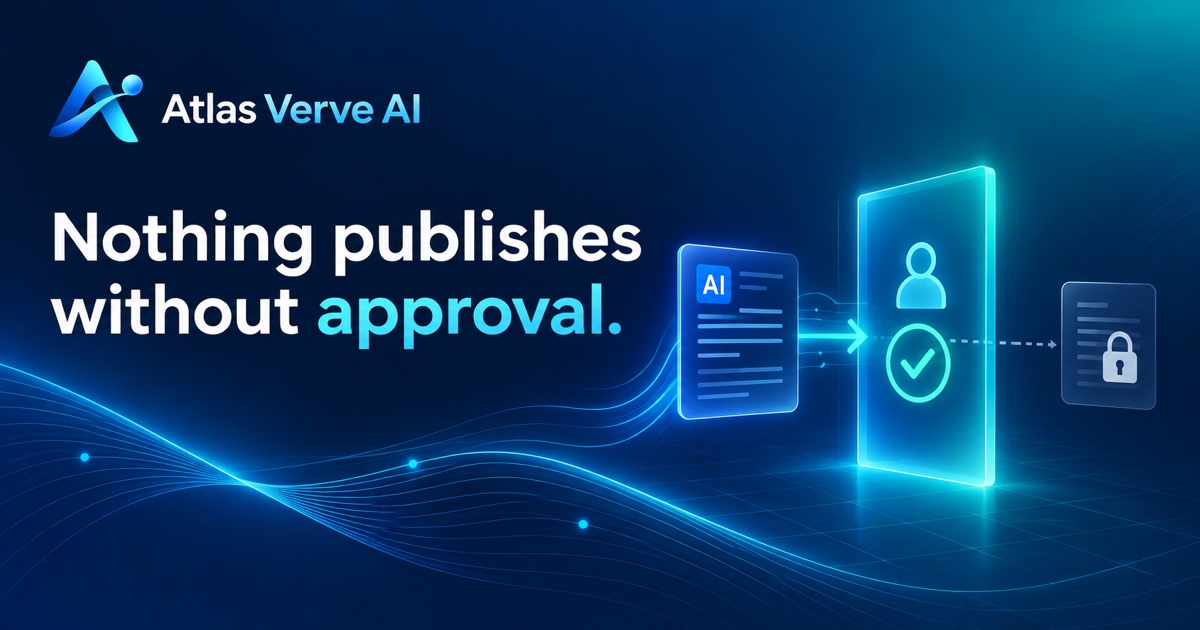
Generation may be automated, but publication should wait in a durable state until an authenticated owner reviews the complete content and confirms the decision. That boundary makes automation useful without making it silent.
For this principle in the Atlas Verve product, see how LinkedIn content approval works from email to review.
For organizational oversight, NIST's AI Risk Management Framework Govern guidance calls for clear human-AI roles and responsibilities.
Identity must match ownership
A review link alone is not authority. The signed-in reviewer should be authorized for the content and destination.
Approval must bind a version
Edits after approval should require a new decision, and delivery retries should reuse the unchanged approved record.
Failures need safe states
Ambiguous LinkedIn responses should stop for investigation when an automatic retry could create duplicate publication.
The workflow
An AI tool approval process before content is published
An LLM or AI agent may prepare a draft, but the workflow must stop before an external publishing action until an authorized person approves the exact version.
-
01
Save generated content before notification
Store the draft and media as a reviewable record instead of sending transient output directly to a publisher.
-
02
Authenticate the reviewer
Require sign-in and verify that the account owns or is authorized to approve the content.
-
03
Present the complete decision
Show the exact text, image, warnings, destination and relevant timing before approval.
-
04
Record approval explicitly
Capture the reviewer, time and final version through a deliberate action; opening an email or page must never count.
-
05
Track dispatch and outcome
Expose whether the approved record is queued, sent, confirmed, failed safely or awaiting investigation.
Worked example
When a publishing result is uncertain
Illustrative workflow scenario: the owner approved a post, but the publishing service has not confirmed whether LinkedIn accepted it.
The tempting shortcut
Send the approved post again immediately.
The controlled next step
Keep the approved version unchanged, mark the result for investigation and confirm whether a LinkedIn post exists before retrying.
Approval covers a specific version, not unlimited attempts. Investigating an uncertain result protects the creator from an accidental duplicate publication.
Put it to work
Where automation must wait for a person
A safe publishing design makes the boundary visible in the state of the post. This illustrative map separates work the system may prepare from the decision only the owner can make.
- Draft ready
The system saves the content and can notify the owner. It cannot publish.
- Under review
The authorized owner checks claims, complete media and destination, then edits, declines or approves the exact version.
- Approved
Only this recorded version is eligible for dispatch. A material edit returns it to review.
- Dispatch uncertain
If LinkedIn has not confirmed the result, investigate whether a post exists before trying again.
- Published or failed
Record the confirmed link or the reason delivery stopped so the owner knows what happened.

01
Approval boundaries for AI agents
If an AI agent can call a publishing tool, require a review checkpoint before that tool changes anything outside the workspace. Show the proposed text, media, destination and source context; verify the reviewer has authority for that destination; and bind the decision to the version that will be sent. Atlas Verve applies this boundary to its LinkedIn workflow. Email can notify the reviewer, but cannot bypass the decision.
02
Retries must respect idempotency
A safe retry repeats the approved delivery operation without regenerating content. Uncertain external outcomes require conservative handling.
03
Auditability should help users
Stable identifiers, plain-language milestones and local timestamps make controls understandable instead of hiding them in technical logs.
Common questions
Clear answers before you begin.
What is human-in-the-loop approval for LLMs?
It is a deliberate checkpoint where an authorized person reviews an LLM's proposed output and the action it would trigger, then approves, edits or declines that specific version before the action happens.
Does human-in-the-loop mean someone watches every AI step?
No. It means a defined human decision is required at the point where judgment or external impact demands it.
Can an approval link publish immediately?
It should not. A safer design opens an authenticated review where the authorized user confirms the exact version.
What if LinkedIn does not confirm publication?
Atlas Verve treats an uncertain result as an investigation state so it does not create a duplicate post by retrying blindly.